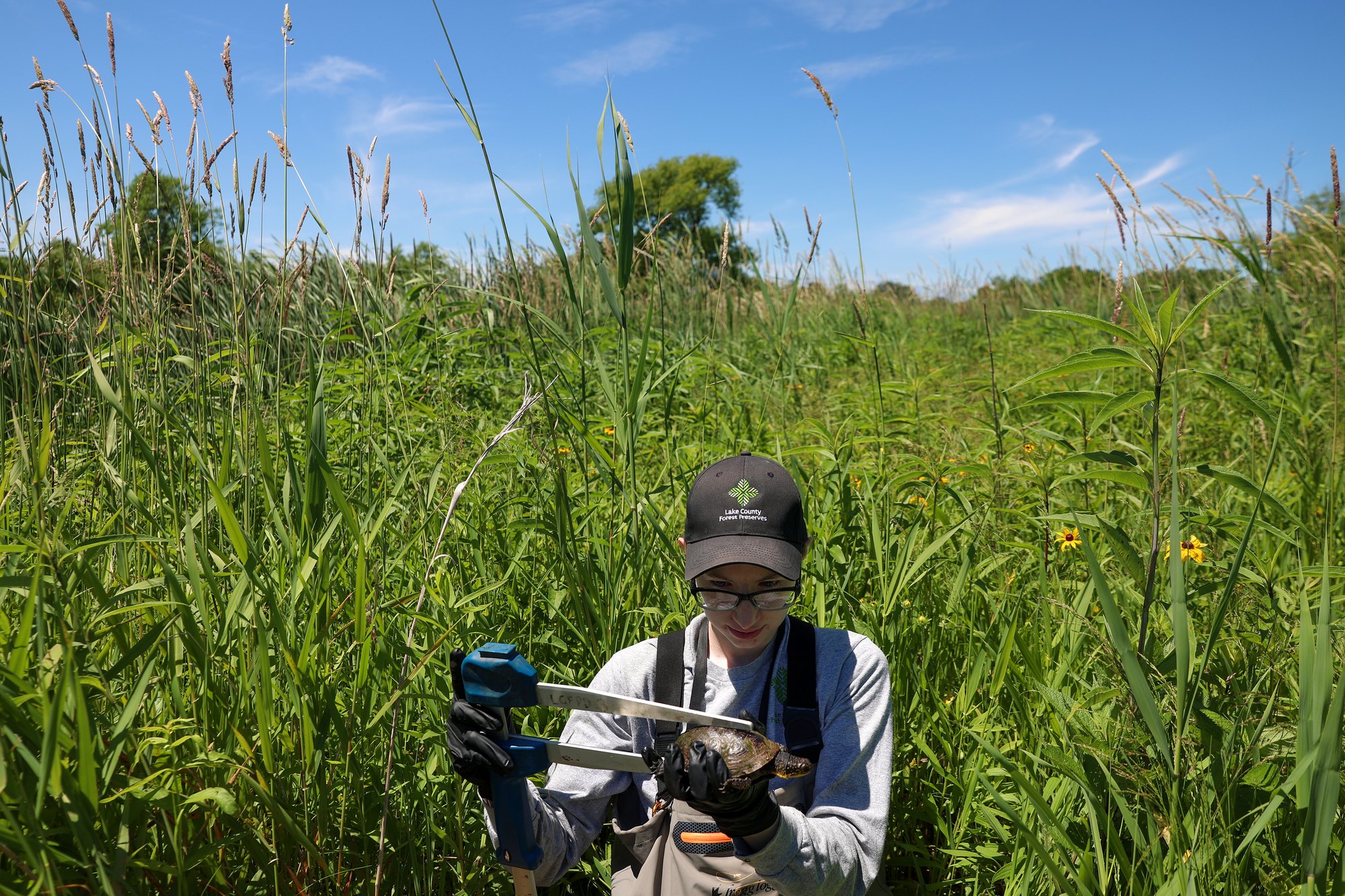
Fifty endangered Blanding's turtles turned up in Lake County wetlands over four days in late June, captured in sardine-baited traps by a team of more than 20 veterinarians and biologists wading through coastal marshes in the county's eastern wetland corridors.
The annual "Blanding's Bowl," held Monday, June 22, through Thursday, June 25, is part friendly competition, part urgent science. Teams from multiple institutions, including the Lake County and Cook County forest preserves, split up across more than 100 trap sites to locate, examine, and release the state-endangered reptiles. One biologist told the Chicago Tribune that tinned fish coated in sriracha makes the best bait.
"For an endangered turtle, that's pretty remarkable," said Gary Glowacki, manager of conservation ecology at the Lake County Forest Preserves District, of the 50-turtle count.
Fewer than 500 Blanding's turtles remain in Illinois. Lake County holds the state's largest "assurance population," the group scientists consider most likely to survive the next 50 to 100 years. The primary population lives in the Chiwaukee Illinois Beach Lake Plain, a coastal area near Lake Michigan that the Lake County Forest Preserves has monitored since 2004.
The effort has grown fast. Matt Allender, director of conservation medicine and science at Brookfield Zoo and a clinical associate professor at the University of Illinois, started the annual health assessments in 2015 with a tackle box and one part-time vet student. This year, the operation drew scientists from across the region. Participants wore turtle earrings and custom T-shirts, and the Bowl's elaborate point system requires selfies with the turtles.
Among the finds: a 9-year-old juvenile nicknamed "Shrek" that weighed just 117 grams, lighter than a cup of flour, bearing scars from old predation attempts.
Why the work matters
When Glowacki began studying the Lake County population more than a decade ago, the turtles faced a 95% chance of disappearing from the area within 50 years. The population has since stabilized and is growing, thanks in part to a head-start program that has released more than 1,300 young turtles since 2010, according to the Lake County Forest Preserves.
But a rare fungal disease, Emydomyces testavorans, discovered in three wild Blanding's turtles in the county, forced a pause on releases at some sites. A treatment developed by Allender's Wildlife Epidemiology Lab and Brookfield Zoo has a 30% to 40% success rate. Glowacki said the district is "starting to see the light at the end of the tunnel" and plans to resume releasing young turtles in 2027.
The species faces long odds even without disease. Blanding's turtles can live 70 to 80 years but don't breed until age 10 to 14. Raccoons raid most nests within 24 hours. Only about one egg in every 100 to 200 laid produces a turtle that reaches adulthood, Allender told the Tribune.
Illinois has lost roughly 90% of its wetlands to development, according to the Illinois Department of Natural Resources, and the Blanding's turtle now occupies just 22% of its historic range in the state.
Health assessment results from the June event won't be available for several months.