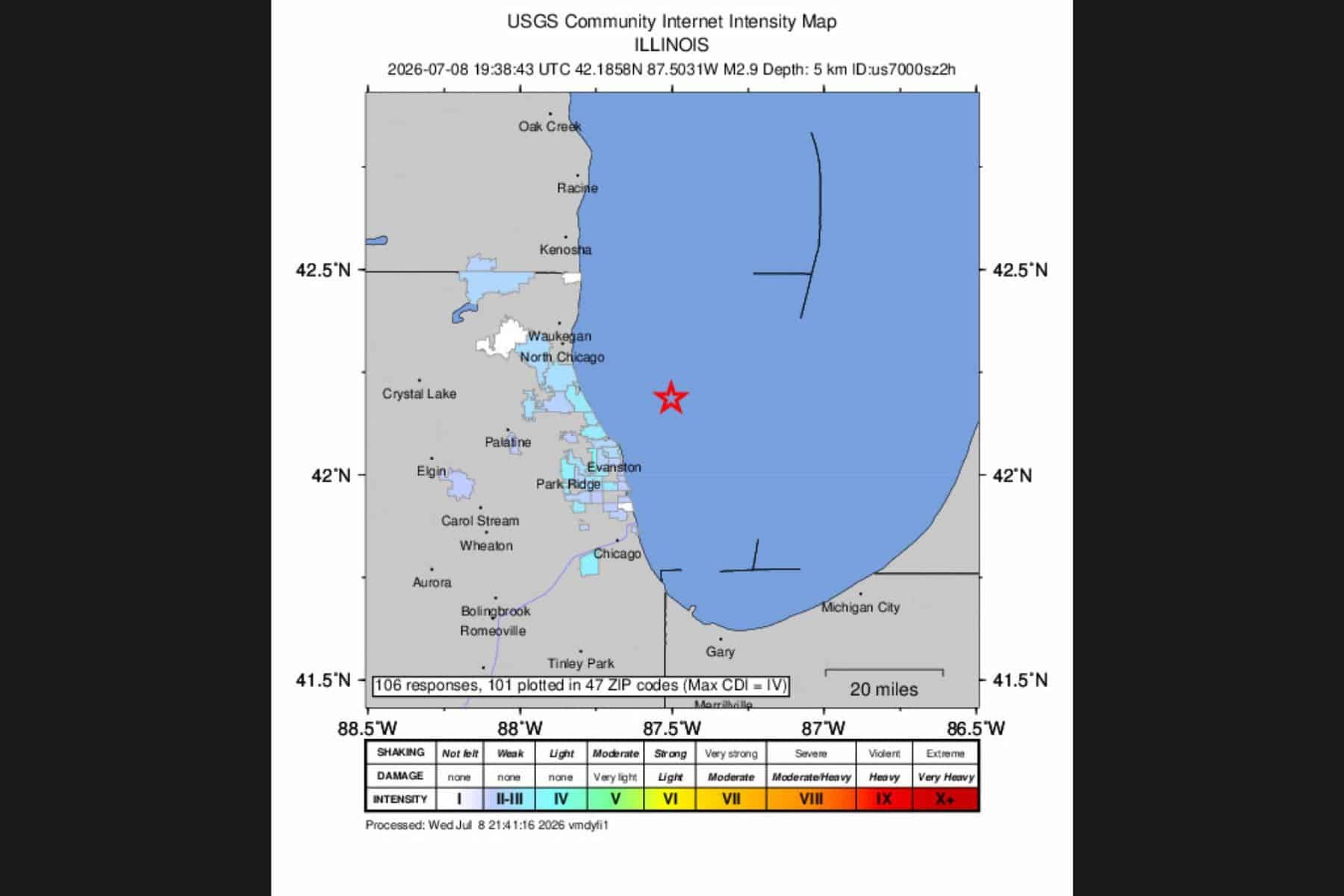
If you felt a rumble on the afternoon of Wednesday, July 8, and blamed it on a passing truck, you weren't alone.
A 2.9 magnitude earthquake struck beneath Lake Michigan at approximately 2:38 p.m. that day, centered about 12 miles off the Kenilworth shoreline and 3.1 miles below the lake's surface. The U.S. Geological Survey confirmed the quake, which was felt from Waukegan south to Chicago's South Side.
The tremor reached well into Lake County. Highland Park, which borders Lake Forest to the south, logged 37 responses to the USGS "Did You Feel It?" program — the second-highest total of any community. More than 400 people across the region reported feeling the quake. Evanston led with 59 responses, followed by Wilmette (16), Skokie (16), and Glencoe (12).
No damage was reported anywhere along the North Shore. North Shore city halls and police departments told CBS News Chicago they received no calls or complaints, though Lake Forest and Lake Bluff were not specifically named among those contacted.
What caused it
No major fault lines run beneath this stretch of Lake Michigan. Meteorologist Tom Skilling, writing on Facebook, attributed the quake to a process called "isostatic rebound."
"It was likely the product of the bedrock beneath Lake Michigan still very slowly shifting and rebounding in the wake of the removal of the mass of ice from the last ice age," Skilling wrote.
The concept: during the last ice age, massive glaciers pressed down on the Earth's crust. Thousands of years after that ice melted, the bedrock is still slowly rising back to its original position. That gradual movement occasionally produces small quakes.
Dr. Suzan Van Der Lee, a Northwestern University Earth scientist, confirmed to CBS News Chicago that the Chicago area sits far from any active earthquake zone. Any fault lines beneath the lake would be hundreds of millions, if not billions, of years old, she said.
How rare is this?
Extremely. According to USGS records cited by CBS News Chicago, only one other earthquake has been recorded in Lake Michigan in the past century: a 2.9 magnitude quake on August 2, 2024. The USGS notes that most of North America east of the Rocky Mountains experiences infrequent seismic activity.
Should residents worry?
Dr. Van Der Lee said aftershocks are possible but unlikely to be felt, as they would be much softer than the July 8 event. She also ruled out any tsunami risk: the quake occurred about 3.1 miles underground, and it's unlikely the lakebed moved, which would be required to generate a wave.
According to the USGS, earthquakes below magnitude 4.0 do not cause damage.
The USGS event page for the quake is listed under ID us7000sz2h for anyone who wants to log a late "Did You Feel It?" response.